
The scale lies. Measurements don't.
Weight fluctuates by 2-3 pounds day to day from water alone. Body measurements tracked consistently over weeks show what's actually changing, and how your nutrition is driving it.
The short answer
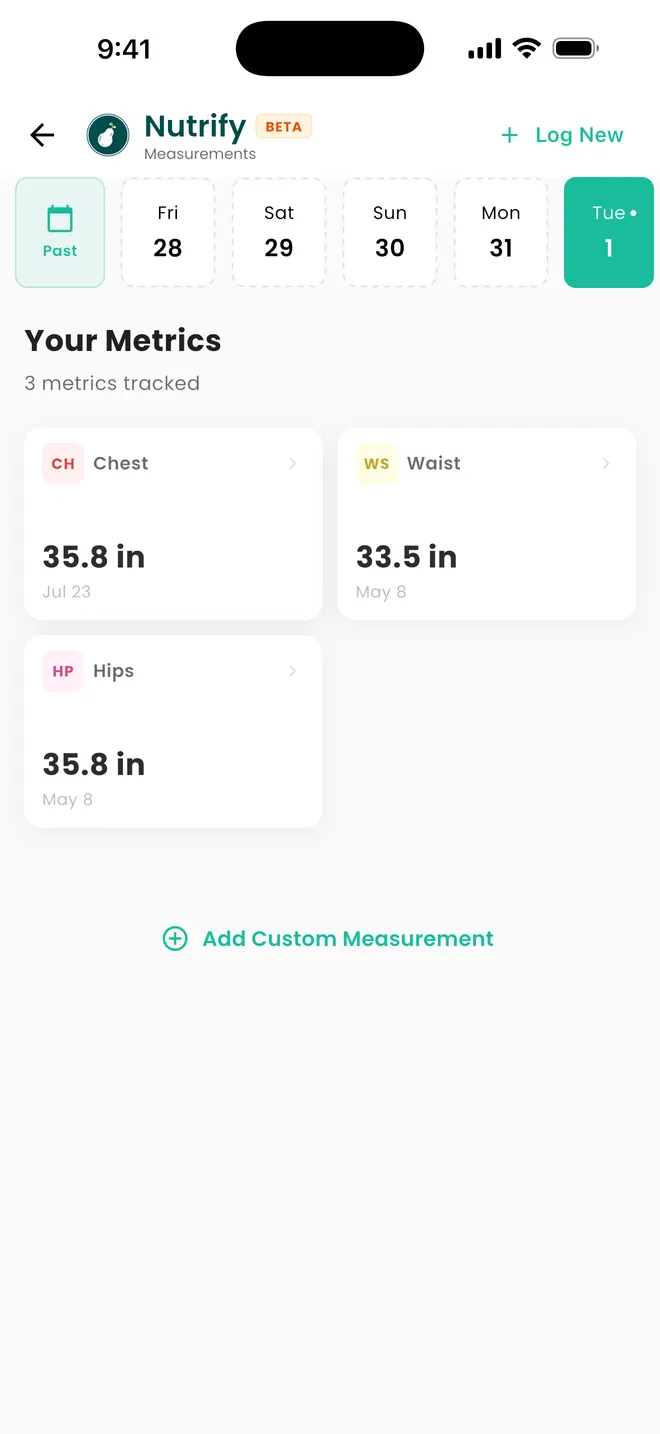
Nutrify tracks chest, waist and hips, plus any custom measurement you want to add, and keeps a separate history for each one so you are reading a trend rather than a single number. Measurements sit alongside your weight, nutrition and activity data in the same app. The section is labelled BETA, which is a scope statement: it does sites and history, not a full body composition model.
Why it matters
Body weight is the most commonly tracked physical metric and often the most misleading one. It fluctuates significantly based on water retention, food volume, hormones, and timing, to the point where someone can be making excellent progress and see the scale move in the wrong direction for an entire week. Body measurements (waist, hips, chest, arms) change more slowly but more meaningfully. They show actual changes in body composition that the scale can't capture. Combined with nutrition data, measurements give you a way to understand cause and effect: whether the changes in your body are being driven by your diet, your training, or neither.
What is body measurement tracking?
Body measurement tracking means recording girths, usually chest, waist and hips, with a tape measure at regular intervals and watching how they change. It exists because body weight is a poor short-term signal. Weight moves with water, food volume in the gut, sodium, hormones and the time of day, so a week of real progress can show up on the scale as a gain. Girths move more slowly and for fewer reasons, so a waist that is down over six weeks is telling you something the scale cannot. The trade-off is measurement error: a tape held at different tension, at a slightly different height, or over a stomach you have unconsciously pulled in will move the number more than a week of dieting will. That makes technique and consistency the entire game, and it is why a history per site matters more than any single reading.
How it works in Nutrify
Simple enough to actually do every day
Log your starting measurements
Add your baseline, weight, waist, chest, arms, hips, or any custom metric you want to track.
Update regularly
Check in weekly or monthly to add new measurements. Consistency over time is what makes the data meaningful.
See the trend alongside your nutrition
View charts showing how each measurement changes in relation to your dietary data.
Chest, waist, hips and anything else
Chest, waist and hips, tracked alongside your weight
Why Nutrify specifically
Built for this, not bolted on
Track what the scale misses
Body measurements show actual composition changes over weeks and months, the story weight fluctuations obscure.
Connected to your nutrition data
See your measurements alongside your calorie and protein data to understand what's actually driving the changes.
Progress photos included
Pair measurements with progress photos to see the full physical transformation, not just data points on a chart.


Waist is the measurement carrying the most information
If you only track one girth, track your waist. It responds to changes in fat mass relatively early, it requires no equipment beyond a tape, and combined with hip circumference it gives you waist-to-hip ratio, which is widely used as a rough indicator of where you carry weight rather than just how much you weigh. That distinction is the reason to bother: two people at the same BMI can carry it very differently, and BMI has no way to tell them apart. Our free waist-to-hip ratio calculator does the arithmetic if you would rather not, and BMI sits in the app's analytics view for whatever it is worth.
Measure the same way every time or you are recording tape error
The most common reason measurement data looks like noise is that the method changed, not the body. Four things to fix and then never think about again: same time of day, ideally first thing before eating; the same anatomical landmark each time, such as the narrowest point of the waist or a fixed distance above the navel; the same tape tension, snug enough to sit flat without compressing the skin; and a relaxed, normal breath out rather than a held stomach. Write down which landmark you chose. Six weeks later you will not remember, and a two centimetre shift in where you put the tape swamps a real change.
Weekly is enough, and monthly is not lazy
Girths change slowly. Measuring daily gives you a chart of your tape technique and your gut contents, and the noise is large enough to hide the signal entirely for the first fortnight. Weekly is the usual compromise, and monthly is perfectly defensible for chest and hips, which move more slowly than the waist. The instinct to measure more often when progress feels slow is understandable and makes the problem worse, because more frequent readings mean more variance, which means more chances to read a bad measurement as a bad week.
Custom measurements are the point, not a fallback
Chest, waist and hips are the defaults because they suit most goals, but they are not everyone's goal. Arms and thighs matter if you are training for size, calf and neck feed some tape-based body fat estimates, and plenty of people track something specific to their own situation. Nutrify lets you add a custom measurement with its own history, so it is treated as a first-class metric rather than a note in a text field. The value comes entirely from the history, so name it precisely and record it the same way each time.
It is labelled BETA, and that is a scope statement
The measurements section carries a BETA label in the app and we would rather explain it than hide it. It is deliberately small: the three sites most people track, custom entries for anything else, and a history per metric so you can see the trend. It is not a body composition suite. If you want caliper sites, girth-based body fat formulas or fat-free mass index, those are on the website as free calculators, and they do the arithmetic in the browser without needing the app at all. We would rather point you there than pretend the app does something it does not.
What users say
Reviews from the App Store
Nutrify has been such a huge part of me getting my life back on track. I'm on a weight‑loss and diabetes journey, and for many I felt like I didn't having any direction and hoping for the best. This app finally gave me something solid to hold onto. I LOVE the analytics! It actually helps me understand my food, my numbers, and my habits in a way that makes sense to me. I can see what's helping, what is not, and what I need to adjust without feeling judged or self-conscious about it.
• If you are doing intermittent fasting or just trying to eat decently, this app is for you. • If you want to take a pic of your meal, instead of looking up every part of it, this app is for you. • If you want to track your exercise and measurements progress, this app is for you. • If you want to track your water intake, this app is for you. Yes, Nutrify Tracker does all of those things and more.
I've been through at least 6 food trackers and this one is the keeper. Just started GLP-1, you find out really quickly that you need to track your nutrients, and this app tracks everything I need: protein, fiber, carbs, calories, weight progress. It specifically supports a GLP-1 diet nutrient focus (gives you the choice of several other diets too). The interface is super easy, take a photo of your food, the AI nutrients estimates are very accurate. And important for GLP-1 users, it lets you adjust your meal based on actual consumption ( because you know you can never finish your whole meal).
FAQ
Body Measurements questions, answered
Waist first, since it responds relatively early to fat loss and needs no equipment. Add hips if you want waist-to-hip ratio, and chest if you want a broader picture of shape change. Beyond that, track what matches your goal: arms and thighs if you are training for size. More sites is not better, because every extra site is another chance to measure inconsistently.
Weekly for the waist, weekly or monthly for everything else. Daily measurement mostly records tape technique and how full your gut is, and the noise from that is bigger than a genuine week of change. If progress feels slow, measuring more often makes it harder to see, not easier, because you add variance without adding signal.
Two conventions are both common: the narrowest point of the torso, or level with the navel. Either works. What matters is that you pick one, note which you chose, and use it every single time. Stand relaxed, breathe out normally without holding your stomach in, and keep the tape flat and level all the way round, snug but not compressing the skin.
Usually water. Weight moves with sodium, carbohydrate intake, gut contents, hormones and training stress, and any of those can add a kilo or two for a week while fat mass is falling. A waist that is trending down while the scale is flat or up is the classic case for tracking both rather than one, and it is precisely the week people quit if the scale is all they have.
They answer different questions. BMI is weight scaled to height and knows nothing about composition or where you carry weight, so a muscular person and an untrained one can land in the same band. Waist-to-hip ratio captures distribution, which BMI ignores entirely. Neither directly measures body fat. Nutrify shows BMI in analytics, and the free calculators on the site cover waist-to-hip ratio, body fat and FFMI.
Yes. Alongside chest, waist and hips you can add custom measurements, and each one keeps its own history so you can see it trended over time rather than as a series of loose entries. Name it precisely, because the value is in comparing readings taken the same way over months.
Nutrify's analytics view shows lean body mass percentage alongside BMI and BMR. For a tape-based body fat estimate, use the free body fat calculator on the site, which works from girth measurements you can take yourself. All of these are estimates from formulas rather than direct measurements of your composition, which is worth remembering before you read too much into a single decimal place.
No, though a flexible fabric or plastic tape is much easier to keep flat and level than a builder's metal one. A spring-loaded tension tape removes one source of error by pulling to a consistent tightness. Whatever you use, use the same one every time, because tapes differ enough to shift a reading on their own.
Nutrify is free to download on iOS and Android and measurement tracking is part of the app. It is labelled BETA, which means it is intentionally limited to sites and history rather than a full body composition tool. The paid tier has a 7-day trial and can be cancelled at any time.
And you also get
Body Measurements is one piece of it.
Every Nutrify user gets the full app: AI food recognition, analytics, health integrations, and everything below.
Nutrition Analytics
Nutrify's analytics show your nutrition trends over days, weeks, and months, so you can see what's actually working, what's not, and where the gaps are.
Health Score
Hitting your calorie target doesn't mean you're eating well. Nutrify's Health Score looks at your full diet (fiber, protein, sugar, micronutrients) and gives you an honest number.
Exercise Tracking
Exercise changes what your body needs. Nutrify tracks your workouts and adjusts your calorie targets automatically, so you know exactly how much to eat without under or overfueling.
Apple Health & Google Fit
Nutrify syncs with Apple Health and Google Fit so your food data and activity data live together. Your calorie targets adjust automatically based on what you actually burned.
Meal Logging
Most food diary apps fail because logging a meal takes longer than eating it. Nutrify flips that: photo, voice, barcode, or text, your meal is logged before you put down your fork.
Keep reading
Ready to try Body Measurements?
Free to download. Every feature free for 7 days, and you can cancel any time.