
How healthy is your diet, actually?
Hitting your calorie target doesn't mean you're eating well. Nutrify's Health Score looks at your full diet (fiber, protein, sugar, micronutrients) and gives you an honest number.
The short answer
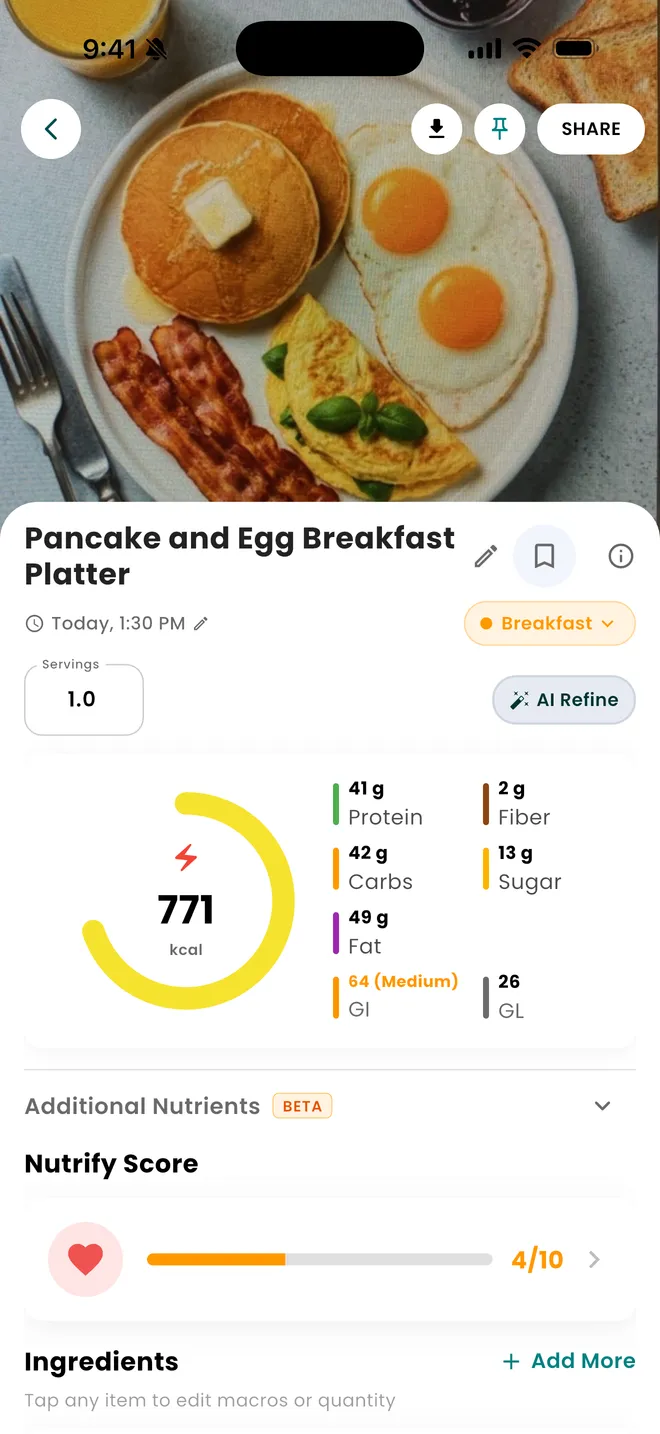
The Nutrify Score rates a meal from 0 to 10 on nutritional quality rather than on calories alone, and it is tracked as a trend so you can see whether your eating is drifting up or down over weeks. A 700 calorie meal built on protein, fibre and vegetables and a 700 calorie meal built on refined carbohydrate and oil score differently, which is the entire reason the number exists. It sits on the meal, where the decision you might change actually lives.
Why it matters
Calories are the most tracked nutrition metric and often the least meaningful one in isolation. A 1,800 calorie diet built on processed food, low fiber, and minimal protein looks identical to a 1,800 calorie diet built on whole foods, lean protein, and plenty of vegetables, until you look at the full nutritional picture. A health score that accounts for the quality of what you eat, not just the quantity, gives you a much more useful signal for making improvements. It's the difference between knowing your balance and knowing whether your diet is actually working for your body.
What is a diet health score?
A diet health score compresses the nutritional quality of a food or a meal into a single number or letter. Several exist publicly: Nutri-Score grades packaged products from A to E, NOVA classifies foods by degree of processing, and the Healthy Eating Index scores a whole diet against dietary guidelines. They use different inputs and they disagree with each other in places, because scoring requires deciding what counts as good, and reasonable people weight fibre, saturated fat, sugar, sodium and protein differently. That is worth knowing before you take any score too literally. What a score is genuinely good at is comparison. Held constant, applied the same way to every meal, it lets you rank your own options against each other and watch your own trend move. What it cannot do is deliver a verdict on whether a food is good or bad in isolation, and any app implying otherwise is overselling arithmetic.
How it works in Nutrify
Simple enough to actually do every day
Log your food as usual
Track your meals with Nutrify, the more you log, the more accurate your score.
Check your daily Health Score
Your score updates with every meal you log. It lives on your dashboard, always visible.
Drill down to improve
Tap the score for a breakdown of what's helping and what's holding it back, with specific guidance.
Snap a meal, see the calories
AI logs your calories and protein in seconds
Why Nutrify specifically
Built for this, not bolted on
Quality, not just quantity
A 1,800 calorie day of pizza scores differently from 1,800 calories of whole foods. The score captures what calories alone can't.
Trend over time, not just today
See how your score improves day to day and week to week as your habits shift.
Know exactly what to improve
Tap the score to see which nutrients are pulling it up or down, with specific, actionable guidance.


Every diet score is an editorial judgement with a number attached
There is no objective formula for how healthy a meal is. Nutri-Score, NOVA and the Healthy Eating Index all exist, all take different inputs, and all disagree in places, because someone had to decide how much fibre offsets how much saturated fat. The Nutrify Score is the same kind of object: a defensible weighting, not a law of physics. That is why we treat it as a comparison tool rather than a verdict. Used against itself, over your own meals and your own weeks, it is genuinely informative. Used to declare one food good and another bad in isolation, it is doing more than the arithmetic supports, and we would rather say so than let a 3 out of 10 ruin your dinner.
Scoring the meal is more useful than scoring the day
A daily diet score is a satisfying number and an almost useless one, because it cannot point at anything you could change. You ate a 6 out of 10 day; now what. The Nutrify Score sits on the individual meal, which is the level at which decisions are actually made. It says this specific lunch scored where it did, and since you can see the meal's ingredient breakdown next to the score, the reason is usually obvious within a couple of seconds. That is the difference between a metric that describes your day and one that changes tomorrow's lunch.
A high score is not permission to ignore the total
Quality and quantity are separate axes and a score only measures one of them. A salad heavy with olive oil, nuts and avocado can score very well and still land near 900 calories, and a modest portion of something ordinary can score poorly while barely touching your budget. Neither fact is a contradiction. This is the single most common way people misread a quality score: as a proxy for whether the meal fits the day. It is not. Read the score for composition, read the calorie and macro figures for fit, and be suspicious of any app that collapses the two into one verdict.
The score you should care about is the trend, not the meal
One meal scoring 4 tells you about one meal, and there is no diet worth following in which every meal scores well. What matters is where the line goes across 7, 30 and 90 days. That is where a change in habit shows up and where a slow drift becomes visible before it shows on the scale. It is also the view that is honest about bad weeks: a single low score is noise, three weeks of a falling average is a pattern. Nutrify tracks the score over time in analytics for that reason, and the trend view is where we would suggest you actually look.
The score grades your log, not your food
This is the limitation worth knowing before the number annoys you. If you logged a stir fry without the two tablespoons of oil it was cooked in, the score reflects a dish nobody ate. If a photo estimate missed the dressing, the same applies. Scores are computed from the nutrition data attached to the meal, so an incomplete log produces a flattering score and a suspiciously generous day. When a score looks wrong, the first thing to check is whether the ingredient list matches what was actually on the plate, and editing the meal is usually a faster fix than doubting the number.
What users say
Reviews from the App Store
Nutrify has been such a huge part of me getting my life back on track. I'm on a weight‑loss and diabetes journey, and for many I felt like I didn't having any direction and hoping for the best. This app finally gave me something solid to hold onto. I LOVE the analytics! It actually helps me understand my food, my numbers, and my habits in a way that makes sense to me. I can see what's helping, what is not, and what I need to adjust without feeling judged or self-conscious about it.
I am an advanced user of intermittent fasting and have tried practically all serious applications of its kind. I tried Nutrify for a while and it seems to me that they have done an excellent job and a fairly complete vision of what the habits mean that we all seek to improve our nutrition. They are doing better than many veteran Apps like LoseIt and Cronometer!
I've tried many calorie tracking apps but i'd say this is the best one yet, the ai food scanner is really accurate and has been helping me stay on track with its healthy eating recommendations. Overall it's really simple to use and has been keeping me motivated to achieve my goal :)
FAQ
Health Score questions, answered
On a 0 to 10 scale, consistently landing in the upper half across most meals is a reasonable working target, and expecting every meal to score highly is a good way to abandon tracking entirely. The more useful reading is directional: is your average moving up over a month. A score is calibrated against its own scale, so comparing it to a number from a different app tells you nothing.
By weighting the nutrients in a meal, things like protein and fibre pulling upward and heavy refined carbohydrate, saturated fat, sugar and sodium pulling downward, into one figure. Every scoring system chooses its own weightings, which is why Nutri-Score, NOVA and the Healthy Eating Index reach different conclusions about the same food. Treat any score as one defensible opinion rendered consistently, not as an objective measurement.
Two usual causes. Either the log is incomplete, which is by far the more common one, since a missing cooking oil or a dressing changes a meal's profile substantially, or the meal genuinely leans on something the score weights against, such as a large amount of saturated fat in an otherwise wholesome dish. Check the ingredient breakdown first. If it does not match the plate, fix the log rather than the meal.
No, and conflating the two is the most common misreading of any diet score. Nuts, olive oil, oily fish and avocado are calorie dense and nutritionally strong, so a meal built around them can score well and still be large. Quality tells you about composition, calories tell you whether it fits your day. You need both numbers, and neither substitutes for the other.
Nutri-Score is a public front-of-pack labelling scheme that grades packaged products A to E, and it is designed for products on a shelf. The Nutrify Score rates a meal you actually ate, including home cooking and restaurant food that carries no label at all, on a 0 to 10 scale. Different inputs, different purpose, and they will not agree on everything.
No. A quality score cannot tell you whether you are in a deficit, and calories cannot tell you whether your diet is nutritionally sound. They answer separate questions and they can move in opposite directions, which is the interesting case: a flat calorie trend with a rising score means the composition improved while the total held steady.
The usual levers are more fibre from vegetables, pulses and whole grains, more protein spread across meals rather than piled into one, and less reliance on refined carbohydrate and added sugar. Before changing anything, though, look at which meals actually score lowest, because it is often one repeated meal doing the damage rather than your diet in general.
The score is derived from the nutrition attached to the meal, so it reflects whatever the meal contains once you have finished editing it. That is worth knowing in both directions: correcting an under-logged meal will usually pull its score down, which feels like a punishment but is the score becoming accurate rather than becoming harsher.
Nutrify is free to download on iOS and Android, and the Nutrify Score is covered by the same subscription as everything else rather than sold as an extra. Every feature is open during the 7-day trial; after that it is a paid app, which you can cancel at any time.
And you also get
Health Score is one piece of it.
Every Nutrify user gets the full app: AI food recognition, analytics, health integrations, and everything below.
Nutrition Analytics
Nutrify's analytics show your nutrition trends over days, weeks, and months, so you can see what's actually working, what's not, and where the gaps are.
Meal Logging
Most food diary apps fail because logging a meal takes longer than eating it. Nutrify flips that: photo, voice, barcode, or text, your meal is logged before you put down your fork.
Ingredient Breakdown
Knowing your meal has 600 calories is one thing. Knowing it's the dressing, not the chicken, that's adding 300 of them, that's the information that actually changes what you order next time.
Photo Food Journal
Numbers tell you what. Photos show you why. A visual food diary makes patterns obvious in a way that calorie totals never do, and logging it is as simple as taking the photo.
Body Measurements
Weight fluctuates by 2-3 pounds day to day from water alone. Body measurements tracked consistently over weeks show what's actually changing, and how your nutrition is driving it.
Keep reading
Ready to try Health Score?
Free to download. Every feature free for 7 days, and you can cancel any time.